Music is in you Body and Brain: Not just your ears
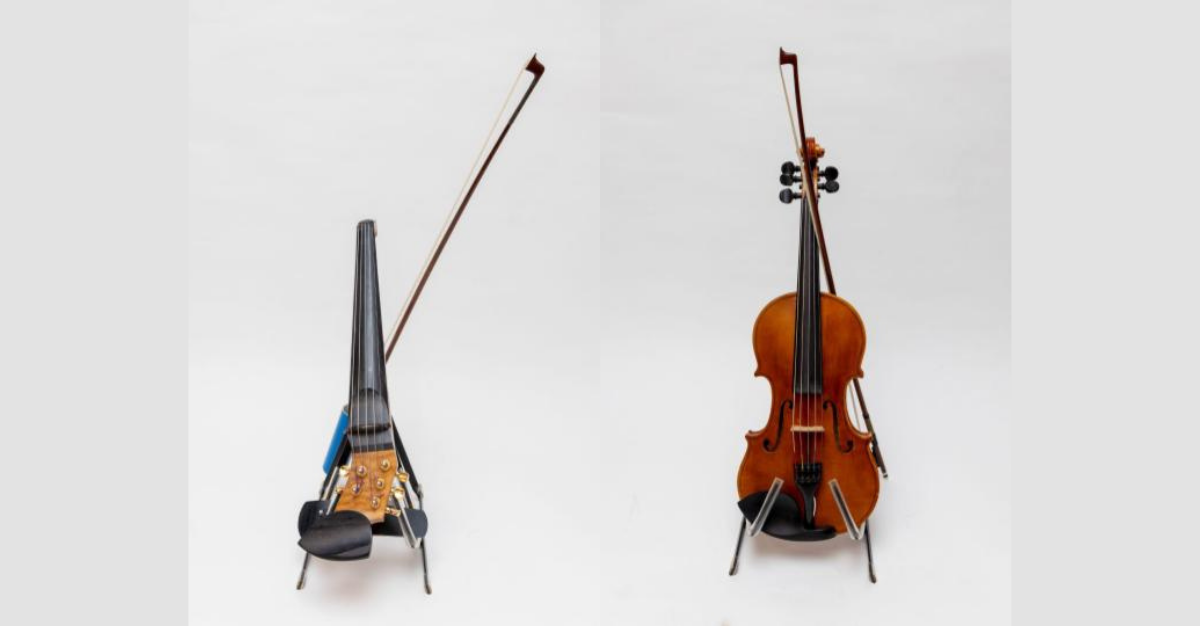
I compose and perform on an electric violin. I have two — one is a solid body Eric Jensen custom and the other is an acoustic electrified by Eric Aceto with his proprietary ISI pickup.
My Jensen had been my go-to instrument for many years. Processing sound through a rack of digital effects and looping is my main form of music making, and it has allowed me to explore the full breadth of reverb, chorus, phase, octaving and harmonizing effects without the acoustic sound mixed in.
In the past couple of years, though, whenever someone has asked me to perform, I’ve reached for my acoustic Aceto. I’ve been observing and wondering why.
When I play acoustic, the vibration moves through the instrument, through my collarbone, through my chest. The sound isn’t arriving at my ears from outside — it’s traveling through me. When I play solid-body electric, the sound is more externalized; it arrives via an external amplifier, and depending on the subwoofer, mix, and speaker size, the vibrations may or may not be felt within my body.
It’s something like the difference between feeling the beat in your feet or chest from a nearby vs speakers playing on the other side of the room.
I attended a mental health panel at the Michigan Music Alliance's Music Econ Summit in Grand Rapids last month, moderated by Philip Tower, M.A. of WYCE, featuring singer-songwriter Caitlin Cusack and music therapist Julie Kastelan. When asked what live music does that recorded music doesn’t, Julie went straight to the body: people literally synchronize heart rates and respiratory rates with each other. A study of choir members found their heartbeats syncing to the tempo. Our bodes are designed to connect.
She went on to explain that playing an instrument is the closest thing to true multitasking the brain can do. It simultaneously activates the cortex, the emotional center, and both hemispheres for movement. Brain scans of people playing instruments light up, in her words, “like Christmas.” Those neural pathways, once built, are resilient — Michigan State’s neurologic music therapy program uses singing to help stroke patients with aphasia relearn language.
I’m a violinist, not a neuroscientist. But it’s clear that learning is not simply cognitive. It is somatic. There are things you learn on a screen and things you learn through your body. Music, writing, painting, dancing, sports, cooking, human connection — these embodied experiences, learned through the complex coordination of movement, decision making, intuition, and feeling. Sound vibrating through the chest, a gesture in dance, scent and visual cues— these are imprinting on physical memory that has no digital equivalent.
Physical and sonic arts are essential for young people today. Not enrichment, but infrastructure. The thing that teaches them they are physical beings capable of receiving and producing meaning through their bodies. It may be the only way to give them a sense of self strong enough to hold its ground when the algorithms start manipulating their behavior.
May 10, 2026